Rubber Line — Track Evolution System
In real Formula 1, the track surface changes throughout a race weekend. As cars lap the circuit, their tires deposit rubber onto the asphalt, creating a dark “racing line” — the fastest path through each corner. The Undercut simulates this with a two-part system: a visual rubber line (what you see) and a track evolution model (what affects the cars).
The Visual Layer
How the dark line appears on screen
The track surface is rendered as a textured mesh — thousands of triangles covering the road. Each vertex has a brightness value baked into it, ranging from white (clean asphalt) to dark gray (rubber-laid).
Two factors control how dark a given point on the track is:
1. Lateral distance from the racing line — The closer a point is to the optimal driving path, the darker it gets. This uses a Gaussian falloff curve:
darkening = e^(-distance^2 * 4)At the racing line itself (distance = 0), this equals 1.0 — full effect. One car-width away, it drops to ~0.37. Two car-widths away, barely visible at ~0.02. This creates the natural-looking “tire tracks” pattern you see on real circuits.
2. Zone type (braking, cornering, acceleration) — Not all parts of the track rubber up equally:
| Zone | Rubber intensity | Why |
|---|---|---|
| Braking | 85% | Heavy tire load, wheels near lock-up |
| Cornering/Lifting | 55% | Moderate lateral forces |
| Acceleration | 25% | Less scrub, tires mostly rolling |
These values are smoothed over ~40 track indices (~20 meters) to avoid sharp transitions between zones. Braking zones before heavy corners get the darkest rubber buildup, exactly like real F1 circuits.
The final vertex color combines both factors:
rubber = zone_intensity * lateral_falloff * rubber_level
brightness = 255 - rubber * darken_amount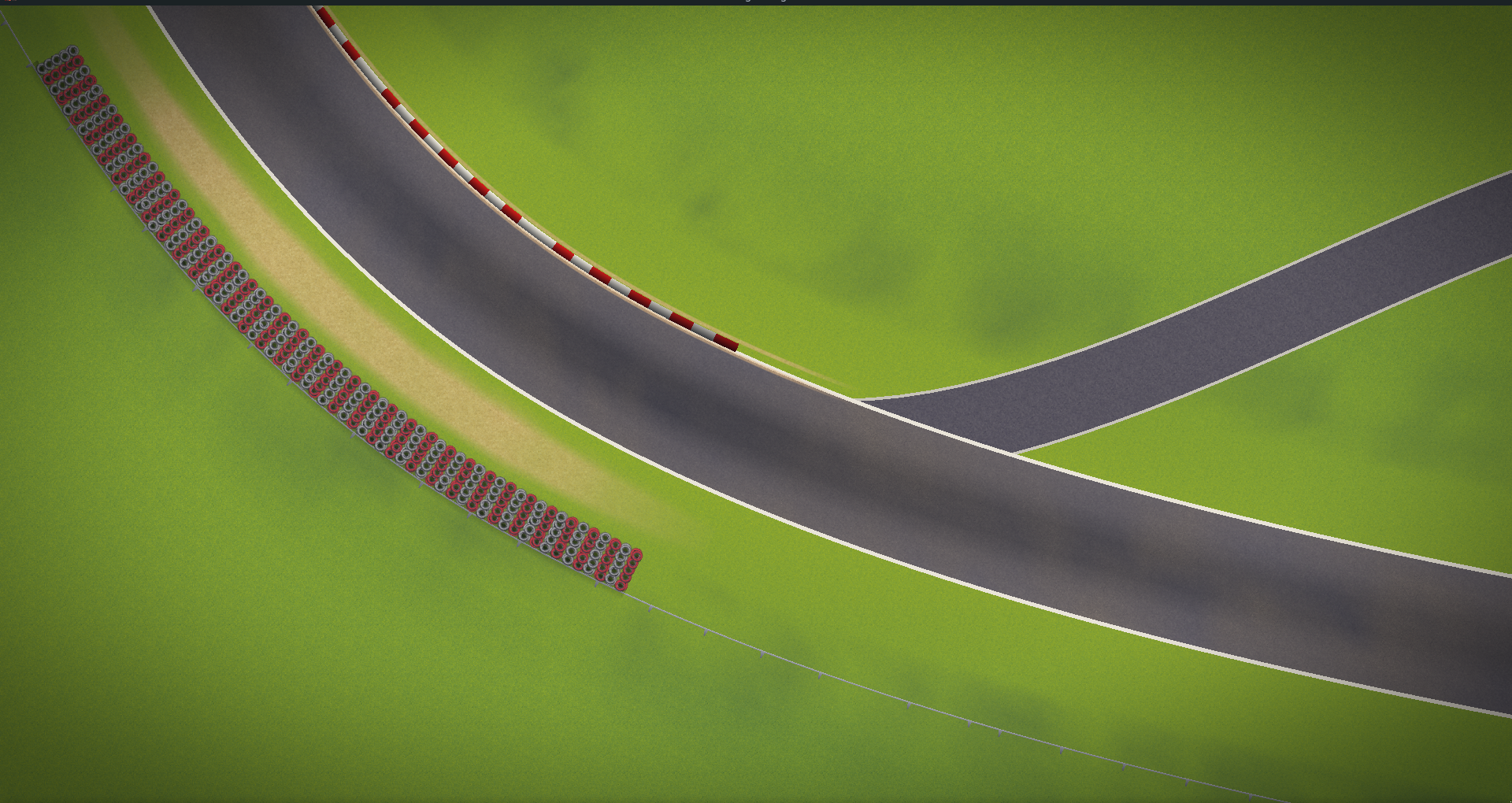
Live rubber level slider
The rubber_level parameter (0.0 = clean, 1.0 = max rubber) controls the overall intensity. At the start of a qualifying session, the track might be at 0.15 (barely visible racing line). By the end of the race, it’s at 0.8+ (prominent dark band).
The asphalt meshes are rebuilt whenever the rubber level changes by more than 1% — this is the visual sync between the simulation and the rendering.
The Simulation Layer
How rubber buildup affects car performance
The sim tracks rubber evolution using TrackState, a simple model driven by total car-laps completed on the surface:
rubber = 1.0 - (1.0 - initial) * e^(-rate * car_laps)With the default evolution rate of 0.003 and 24 cars:
- After 1 lap (24 car-laps): rubber ~ 0.22
- After 10 laps (240 car-laps): rubber ~ 0.59
- After 30 laps (720 car-laps): rubber ~ 0.89
This exponential curve means the track improves quickly at first then plateaus — matching real F1 behavior where the biggest gains happen in the first few laps.
Three performance effects
A green track hurts you in three ways:
Grip penalty — Up to 2% speed loss on a completely green track. This hits hardest in corners (100% effect), moderately under braking (70%), barely on straights (20%). As rubber builds up, this penalty fades.
Tire wear — Up to 25% extra tire degradation on a green surface. Cars slide more on a slippery track, which scrubs the tires faster. This is why the first stint of a race often produces the highest wear rates.
Tire temperature — Up to 5°C lower tire temperature targets. Less rubber means less energy transfer into the tires, making it harder to reach the optimal temperature window. Cold tires = less grip = more sliding = more wear — a compounding problem.
Session continuity
Track rubber carries between sessions:
- Qualifying starts with 10-30% rubber (green weekend track)
- By the end of qualifying, it might reach 35-50%
- The race starts where qualifying left off and continues building
- This means pole position qualifying at the end of Q3 benefits from a more rubbered track than early Q1 laps
What it means for gameplay
-
Practice matters — The practice session builds rubber on the track. Cars that run more laps in practice contribute to better grip for everyone in qualifying.
-
Early laps are tricky — The first laps of qualifying and the race start are on the most slippery surface. This is when mistakes are most likely and tire management is most critical.
-
Track position compounds — Cars running on the racing line deposit more rubber, making that line faster, which rewards cars already following the optimal path. Off-line overtakes are harder because the surface is less rubbered.
-
Strategy window — On a green track, hard tires struggle more (they’re already slower to warm up). This can make qualifying compound choice more interesting — soft tires get up to temperature faster on a green track.